



 Account
 Shopping Cart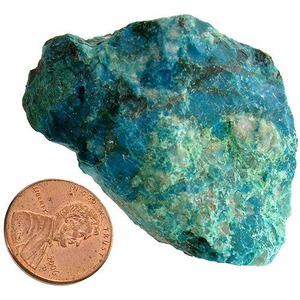
Chrysocolla - Bulk Mineral

Share this product:


Item#: 11203
![5 star rating]() 3 customer reviews
3 customer reviews
![5 star rating]() Chrysocolla Mineral
Chrysocolla Mineral
Brenda Blood from Houston, Texas
The specimen I received is absolutely perfect. I am very pleased with the service and how quickly my item was shipped to me !
![5 star rating]() Beautiful mineral!
Beautiful mineral!
Alex from US, WI, Madison
I ordered a chrysocolla and chalcopyrite specimen for my collection, and they arrived very quickly and were absolutely beautiful. I would highly recommend! The greens and blues were slightly less intense than in the picture, but the full spectrum of color was there so I'm happy!
![5 star rating]() Beautiful Blue
Beautiful Blue
Chris from Pine Island, MN USA
The blue color is penetrating. You can't look at this without "Wow...what is that?"
 3 customer reviews
Chrysocolla is a bluish-green copper silicate ore. Often confused with turquoise, some people believe it is a “woman’s friend” due to its supposed healing properties related to PMS, menstrual pain and other related issues. Also believed to be good for amplifying communication skills and easing broken hearts, this is a very interesting rock to pass along to friends or family. Get one before they run out!
Please be aware that this is a natural mineral and as such each piece is one of a kind! The one you receive may not be exactly the same as the ones pictured but it will be similar. Price is per each piece. They come in irregular shapes, sizes and weights.
Age:
7 +
7 +
Approx. Ship Size:
1.00 x 1.00 x 1.00 inches
2.54cm x 2.54cm x 2.54cm
1.00 x 1.00 x 1.00 inches
2.54cm x 2.54cm x 2.54cm
Weight:
0 lb 2 oz
0.06 kg
0 lb 2 oz
0.06 kg
Warning:
CHOKING HAZARD
Small parts. Not for children under 3 yrs.
CHOKING HAZARD
Small parts. Not for children under 3 yrs.
Customer Reviews
Chrysocolla MineralBrenda Blood from Houston, Texas
The specimen I received is absolutely perfect. I am very pleased with the service and how quickly my item was shipped to me !
Beautiful mineral!Alex from US, WI, Madison
I ordered a chrysocolla and chalcopyrite specimen for my collection, and they arrived very quickly and were absolutely beautiful. I would highly recommend! The greens and blues were slightly less intense than in the picture, but the full spectrum of color was there so I'm happy!
Beautiful BlueChris from Pine Island, MN USA
The blue color is penetrating. You can't look at this without "Wow...what is that?"